
Malheur, the beer that challenged Champagne
Talk about “Misfortune”, in a small town in Flanders, “remuage” applied to beer (not to offend the French).

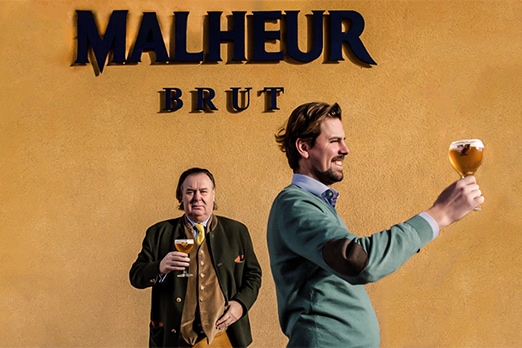
The De Landtsheer are an old Belgian brewing family.
Their dynasty began in 1798, when the patriarch, Balthazar (Nomen Omen), the son of a rich ship builder, decided to change course, founding the De Halve Maan (the Half Moon) brewery – a brand that still exists to this day – in the village of Baasrode, Flanders, with a population of 6,000.
Over the decades the business flourished, first under his son Edward, who assumed the role of Master Brewer, and subsequently under his granddaughter Rosalia, with the help of her husband, who changed the name to Bacchus.
In 1839, Emmanuel, the founder’s grandson, moved to Buggenhout to marry Maria-Anna Sarens.
BRUGGENHOUT, THE SONG OF THE SWAN
But no matter how much you try to run from your destiny, it’ll always catch up with you.
It so happened that the family of Emmanuel’s young bride owned a brewery (the Meuleken), which had been active until 1709.
The newly wed couldn’t help but to get it running again, thus founding, in the same year, the Brouwerij De Zon, the Brewery of the Sun (the reason why to this day the company’s color, found on the tops and labels of the bottles, is orange).
The business prospered for almost a century, until neutral and nonconfrontational Belgium fell victim to Germany’s wrath during the two World Wars.
The country, which became a war zone, was invaded by the Germans twice in less than thirty years: in 1914 with the Schlieffen Plan, and in 1940 with the Fall Gelb Plan, and, against its will, the De Landtsheer family was forced to shut down and cease production.
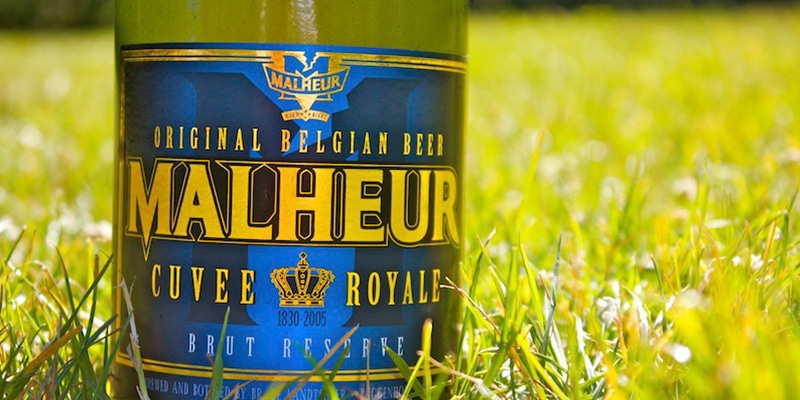
1991: THE ADVENTURE STARTS AGAIN!
Emmanuel (grandson of the previous Emmanuel) was the last member of the dynasty to produce, and his son, Adolf, the first one forced to change occupation.
He began importing and distributing Pilsner Urquell in Belgium and bottling for the Westmalle and Lamot breweries.
Adolf spent his whole life weighed down by defeat while nurturing the undying dream of resurrecting, like a Phoenix from the ashes, the family business, but without success.
He died in 1991, leaving the company in the hands of his son, Emmanuel “Manu” De Landtsheer.
In that dramatic moment, and to honor the memory of his father, Manu decided to take up the baton and realize his father’s dream: the De Landtsheer family would once again make beer!

“MISFORTUNE” OPENS ITS DOORS
Manu tried to buy back the De Halve Maan, the family’s old brewery, but unfortunately this proved to be impossible.
Six years later, with his sister Martine and his mother Monique, he opened Malheur or “Misfortune” (a name which he chose ironically, to symbolically exorcize the troubles of the past), a small family brewery, putting his first wort, Malheur 6 (to this day still in production) on the market.
Luc Verhaegen, “borrowed” from the famous De Koninck brewery in Antwerp, was hired as its master brewer.
But more than Malheur, it was destiny that knocked once again at the De Landtsheer’s door, this time in the guise of Michael Jackson!
No, not “that” Michael Jackson, famous for Thriller and Moonwalker, but the “other” Michael Jackson, The Beer Hunter!
Born in 1942 in a small town just outside of Leeds in England, Jackson was a journalist, a writer, and a TV presenter.
He was the first “beer-taster” in history, a man who, thanks to his books (especially The World Guide to Beer, which belongs on your reading list), helped to save quality beer and styles from certain extinction (though you didn’t know it, he’s the reason that you’re reading this right now and have gotten this far).

IT’S ALL MICHAEL JACKSON’S FAULT
A huge connoisseur of Belgian beer and its blonde ales, in 1999, accompanied by several friends, he showed up in Buggenhout to visit the brewery.
At the end of the guided tour and after tasting the beers in production at the time, he stopped to talk with Manu, saying to him: “What are you dreams? Future plans?”
Malheur’s owner, somewhere between frank and timid, answered almost hesitantly: “I’d like to make a beer the way our neighbors in Ardenne make their champagne.”
“And why don’t you?” urged Michael.
Almost as though shaking himself out of a daydream, Manu bluntly and sincerely responded with: “Because I don’t have potential clients to whom I could sell such a product.”
At this point good old Destiny decided to possess one of Michael’s friends, an American, a beer fanatic, and a member of the U.S. Belgian Beer Club, who, right there in the heart of Flanders, channeled the true spirit of the American Dream. “Don’t worry about it and just do it! I’ll buy the entire first wort!”
To Manu it seemed too good to be true, and he threw himself head first into the project.

THE CHALLENGE TO “FLANDERS’ CHAMPAGNE”
For three years Manu and Luc travelled back and forth along the 236 kilometers that separated them from Notre-Dame de Reims, visiting Vigneron to study production methods, acquire machinery, and find the right yeast (Saccharomyces Bayanus) from the Institut Oenologique de Champagne, in Epernay.
In 2002 Malheur Bière Brut finally debuted, the first beer in the world produced with the mèthode champenoise, as the French would say, with liquèur de tirage, prise de mousse, remuage, dègorgement, and liquèur d’expedition. It was immediately a success!
The Comitè Champagne, bothered by the international press which christened the new beer with the name Bière-Champagne or Bière-Champenoise (terms which are still commonly used), filed a lawsuit against poor Manu.
After five long years of legal battles, the lawsuit finally ended having essentially achieved nothing, given that Malheur never used those terms, and permitting him the use of the eptithets mèthode originale and Bière-Brut.

Over the course of these past nineteen years, Malheur has produced five different Classic Method beers, all absolutely worth tasting, and has inspired numerous copy-cats in Italy as well (from Birra del Borgo’s Equilibrista, to Baladin’s Metodo Classico): Bière-Brut, Brut-Reserve, Dark-Brut, Cuvée Royale, and a Bière-Brut Limited Edition.
And if it’s true that ce n’est pas du champagne si ce n’est pas du champagne, then it’s just as true that ce n’est pas du bière-brut si ce n’est pas du Malheur.
A style was born. The rest his history (or legend).
Ready to join the Vinhood family?


Vinhood is the First Italian Taste Agency. We explore the world of taste to guide people about how to choose and consume products and supporting companies in nurturing personalized relationships with their customers.
Read more
- How to choose the perfect glass for your beer
 If you're a beer enthusiast, you surely know that the right glass can make a difference in the tasting experience. Let's explore the different styles together!
 - Christmas Beers: how to recognize them and why they aren't a marketing gimmick
 Beers with an ancient history that’s worth knowing, even just for a story you can share at Christmas.
 - Is German beer truly German?
 For historical reasons, and due to geographical proximity, in Italy when we think of beer, we can’t help but also think of Germany.. But are you really sure that all German beers are... German?