We like to imagine you in your kitchen with a computer or cookbook in front of you, intent on choosing a new bread recipe.
The recipe that you’ve chosen is straightforward and, in just a few simple steps, explains how to prepare your dough, providing a precise list of ingredients and quantities, followed by a brief description of how to knead it all together.
Your eyes stop on a key element of the recipe and a few initials that follow it. Doubt creeps in: is the flour that you have in your house the right one?
We at VINHOOD will now assuage your every doubt, detailing the most common characteristics that will help you to choose the right flour!
THE STRENGTH OF FLOUR (W): WHAT IS IT?
These days, every mill’s quality control procedures include certain measurements that are fundamental to the proper evaluation, cataloguing, and sale of one’s flours. Among these measurements is the strength of the flour (W), a number that quantifies the resistance (P) and extensibility (L) of the dough.
The “strength of flour” refers to the ability of the flour to absorb water while being kneaded and its capacity to retain carbon dioxide during proofing.
Structurally, flour’s capacity to absorb different amounts of water – producing a dough that’s more or less resistant – depends on the total amount of protein (gliadin, glutenin) and on the relationship between them. Depending on the final protein content, a variable amount of water is absorbed and the final structure known as gluten is formed, a long chain created by the bond between the two aforementioned proteins.
A higher content of gliadin is responsible for the extensibility of the dough while a higher content of glutenin is what determines greater elasticity and therefore resistance.
A flour with high strength (W) values is indicated for products with a long proofing phase, like bread, pizza, and panettone, while weaker flours are indicated for baked goods that don’t require a lot of proofing, like shortbread, pastry dough, breadsticks, or cookies. In the following table you’ll find a summary of the primary flour values and what preparations they’re right for.
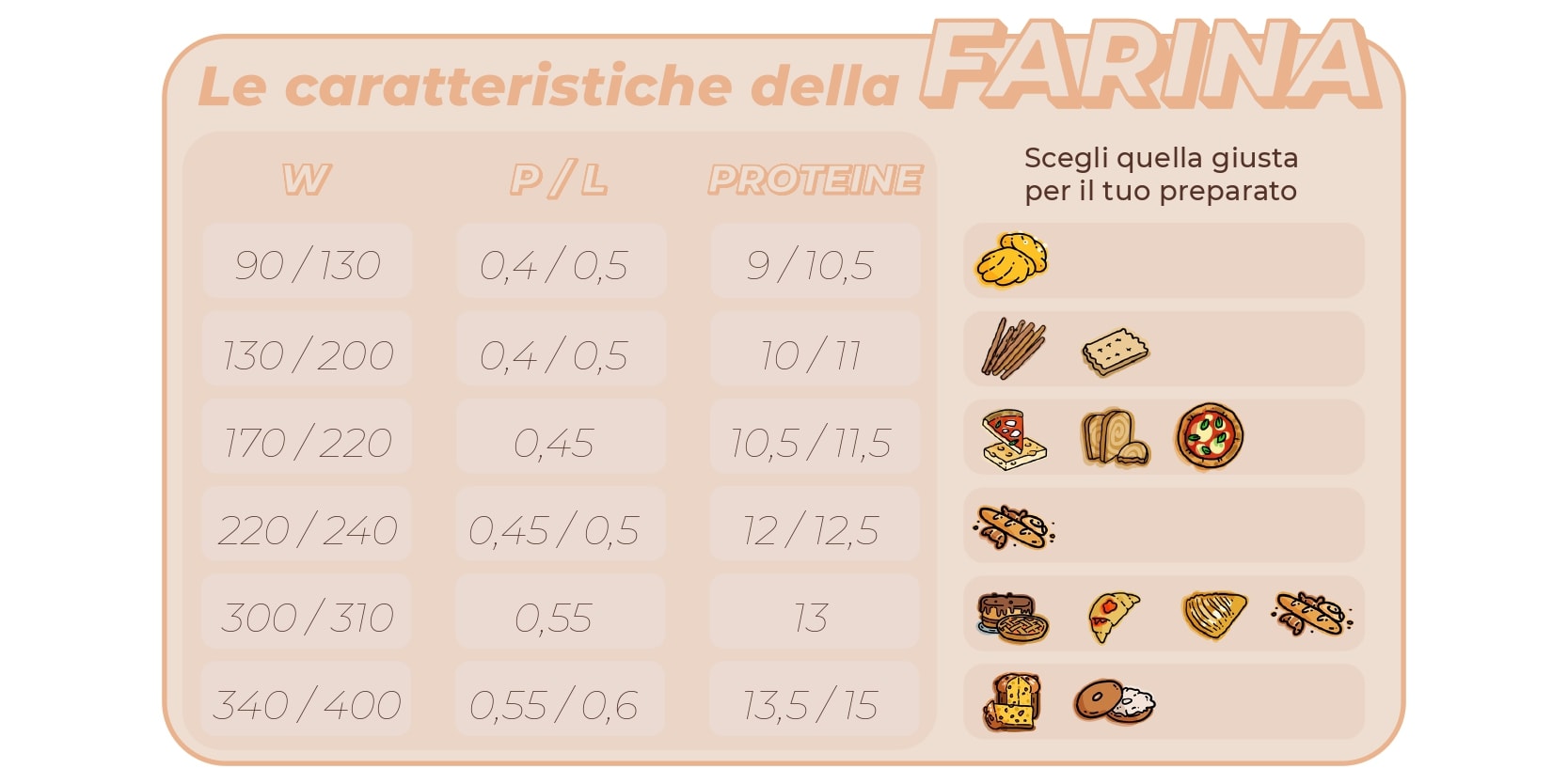
What is the strength (W) range used for bread? Where can one find this information?
For the production of bread it’s recommended to use flours with a medium to high strength, though the choice ultimately depends on the type of bread you wish to prepare. If you want to make a bread that contains fats, like an oil bread or a baguette, then medium strength flours (170 < W < 280) are sufficient. For breads with a longer proofing phase, a crumb that really expands, and substantial air pockets, like kneaded bread, brioche, Neapolitan pizza, and focaccia, we suggest choosing a strong flour (280 < W < 350).
This information is often available on the package or on the producer’s website, making it quick for you to select the flour that you need! What categories do flours fall into?
There are 5 primary categories of flour and each one of these has a range of W values that help us to figure out what it’s best used for.
00 FLOUR or PASTRY FLOUR
This is one of the most refined wheat flours and indicates a flour that has been obtained exclusively from the most internal part of the wheat berry, or rather the endosperm. This flour is rich in starch and has a protein content of approximately 9%. Its W index varies between 90 and 180, making it a weak flour. This flour isn’t suitable for lengthy proofing, but is ideal for cakes, cookies, and shortbread.
0 FLOUR or ALL PURPOSE FLOUR
This is a wheat flour that’s less refined than the 00, but which maintains a homogeneous appearance and a white color. This flour contains a minimal percentage of bran and has a slightly higher protein content of approximately 10%. Its W index oscillates between 180 and 280 making it a medium strength flour. This flour isn’t indicated for cakes and cookies like the previous one, but can be used for breadsticks, breads which contain fats, and breads which do not require a long proofing phase (ex. milk bread).
TYPE 1 FLOUR
This is the milling product of the bran, endosperm, and a small part of the wheat germ. It’s a flour that contains varying amounts of fiber, nutrients, and proteins, making its W index highly variable. The W values vary between 180 and 350 and the protein content is between 11% and 12%. Given this variability, this flour can be classified as medium-strong. It can be used for cakes, cookies, and breads without long proofing phases.
TYPE 2 FLOUR
This is a part-whole wheat flour that’s less refined than the previous ones; it contains more bran and fiber and has a protein content of up to 12%. In this case as well, the W index varies from 180 to 350, creating flours that oscillate between medium and strong. For this reason it can be used for the same preparations as those of type 1 flour.
WHOLE WHEAT FLOUR
Produced from milling the entire grain of wheat. It’s the richest flour in terms of nutritional content: rich in proteins, minerals, and vitamins. It’s protein content hovers between 13% and 14% and its W index varies from 280 to 300, therefore this flour is considered strong. It’s a flour that’s suitable for long leavened and rustic leavened products.
This flour is often used with other flours in order to reduce its strength and make it more suitable to breadmaking. It’s common to have cookies made with a blend of whole wheat flour and type 00 flour and breads made with a blend of whole wheat flour and type 0 flour.
MANITOBA FLOUR
This is the flour with the absolute highest W values, even though it doesn’t contain bran and undergoes a very fine milling process. Manitoba flour is particularly rich in gluten (and therefore proteins) and is therefore able to absorb large amounts of water. This flour is considered strong. Manitoba flour is suitable as a foundation for sweets with a long proofing phase and that are rich in fats, like panettone, pandoro, and colomba.
Hopefully we’ve assuaged all of your doubts regarding which flour and W value are best suited to your recipe.
Now we’ll let you get back to your dough, hoping that the proofing phase goes smoothly thanks to the help of all of those wonderful microorganisms that we talked about in last month’s article!




 Spoiler alert: we’re not talking about the next evolution of brioche and ice cream, but about an actual flavor, one that’s also part of many regional specialties.
 What came first, the hamburger or the bun? And most importantly, are we so sure that the first bun in history was created on the other side of the Atlantic? On occasion of World Hamburger Day, let’s rediscover its origins.
 How much do we really pay attention the bread we eat? What characteristics do we evaluate?