Is the baguette the bread that represents France? Absolutely.
Is it the only bread that French people eat? Not at all. There is an extensive bread baking tradition in France as well, with many regional variations, ranging from fougasse in Provence to soubrot in Alsace, and of course the “country bread” which is similar to Italian bread in many ways, with its large round loaves often made with sourdough starter and less refined flours.
Nevertheless, no type of bread, no matter how delicious, can hope to compete with the baguette: according to a recent statistic, approximately 6 billion loaves are consumed per year in France.
That means that every French person – including children – eats an average of one hundred baguettes each year.
So it’s understandable that the Macron administration has decided to make it a candidate for inclusion on the UNESCO Intangible Cultural Heritage list, putting it ahead of the roofs of Paris.
And yet, it’s not all as rosy as it seems, because even this success story has its bumps.
In fact, over the last fifty years, the number of artisan boulangeries in France has dropped from 55,000 to 35,000 due to both an increase in industrial production and a decrease in consumption, similar to what has happened in Italy as well.
A MODERN LEGEND
Meanwhile, the legendary image of the baguette, the bread that Parisians carry under their arm and eat while out for a stroll, stands firm in our collective imagination, to the point that today (and going back as far as we can remember or at least to when it was invented by Napoleon’s bakers) it is easily thought of as the national bread.
It’s legendary origin is contested by many historians for obvious reasons, starting with the name baguette, or stick, of which there is no record prior to the 1800s.
Two main hypotheses exist. The first places the birth of these wand-like loaves outside of France’s border, some time between the 19th and 20th centuries.
In this case, the baguette’s prototype can be traced to Vienna, alongside the invention of the steam oven. This oven, introduced in the capital of France in 1839 by August Zang, made it possible to start baking products in the Viennoise or brioche category, kipfel (the predecessor to the croissant), and, naturally, the precursor to the baguette.
According to this version of events, this Viennese bread officially became the baguette several decades later when Paris’s subway system was being constructed. The men working at the construction sites needed a type of bread that was easier to carry around and eat.
Et voilà, a Vienna bread that was lighter and longer, that could be broken by hand rather than cut with a knife: the baguette.
However, this version of events is not to the liking of historian Steven Kaplan, who places the baguette’s creation even further back in time. According to his theory, the baguette came from the demand by the Parisian bourgeois class for a type of bread that was smaller in size, with a lot of crust, and whose baking process was simpler and faster, therefore not requiring bakers to be awake all night.
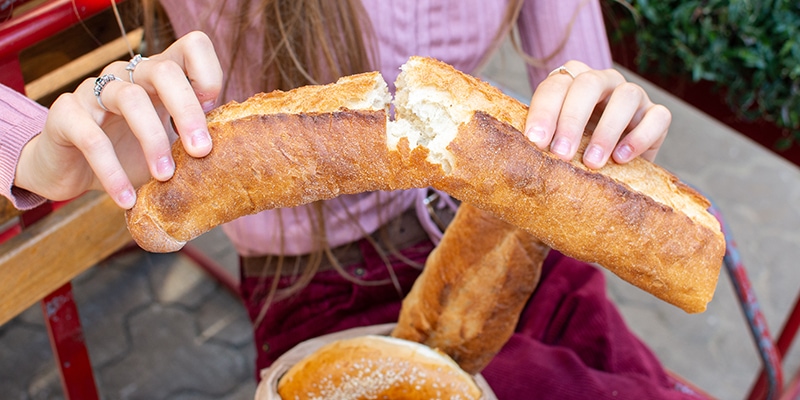
THE CLASSIC BAGUETTE: TRADITIONAL AND “DEMI”
Whatever the origin of the baguette, its success is undeniable and, starting in the 1970s, its wide popularity made it an easily industrialized product.
In order to stem the tide of this process, in 1993 the government led by Édouard Balladur intervened, drafting the famous “Bread Decree” which stated that the “traditional baguette” was not frozen and was made exclusively with wheat flour, water, yeast, and salt.
Other ingredients, as specified in the decree, were allowed but in very limited quantities. Today approximately 1 in 4 baguettes that are sold are considered “traditional”. These are slightly more expensive but also more coveted from a culinary point of view because of their crunchy and flavorful crust.
What are the characteristics of the perfect baguette? These can be deduced by looking at the standards required for admittance to the Le Grand Prix de la Baguette competition in Paris, in which the city’s best bakeries have competed with one another for the past 25 years.
Therefore: length between 55 and 65 centimeters, weight between 250 and 300 grams, and 18 grams of salt for every kilogram of flour.
Elasticity is also an important criterion: after applying gentle pressure, the bread must return to its original shape.
Inside the baguette, the crumb must be soft, but not damp, and must have irregular holes.
Naturally, when it comes to baguettes, everyone has their own preferences, so no one will look down on you if you ask for a well-done or less-done baguette or, if you’re on a diet, request a demi baguette or its little sister, the ficelle (approximately 125 grams), which is perfect for a snack.




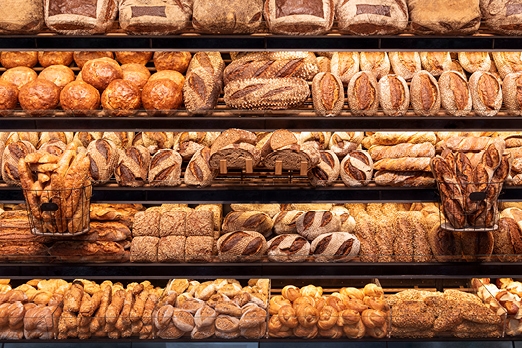 It’s our job to shed some light on baked bread, a universe characterized by countless names, picturesque crumbs, and crusts of various thicknesses and consistencies. It’s here that the #Characters rush to our aid.
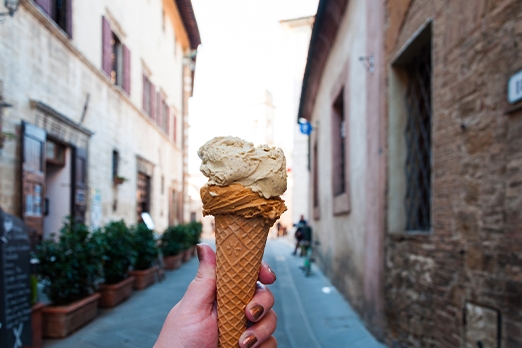 Spoiler alert: we’re not talking about the next evolution of brioche and ice cream, but about an actual flavor, one that’s also part of many regional specialties.
 We like to imagine you in your kitchen with a computer or cookbook in front of you, intent on choosing a new bread recipe. Doubt creeps in: is the flour that you have in your house the right one?