
Do you want to become a black belt in wine tasting? Find out how to train your sense of smell to recognize more aromas in a glass of wine
Are you feeling discouraged because you can’t ever seem to recognize the aromas in a glass of wine? Follow these 10 tips for developing a sense of smell that’s stronger than a bloodhound’s... or so to speak!


The sense of smell isn’t a muscle, and yet it’s possible to keep it in shape thanks to some simple training exercises that help you to recognize more and more aromas.
Because, while it’s true that you’re only at the beginning of this long and marvelous journey that is wine, Mr. Miyagi also makes a good point when he says:
“Walk on road, hmmm? Walk right side, safe. Walk left side, safe. Walk middle, sooner or later… get squish just like grape.
Here, karate same thing. Either you karate do ‘yes’, or karate do ‘no’. You karate do ‘guess so’, squish just like grape.”
And with that, I will now unveil my 10 tips for becoming a black belt in wine tasting.
Spoiler alert: some of these methods are also used to help people recover their sense of smell after losing it due to Covid.
1) Know what the aromas in a wine can be
It may seem trivial, but the first step in understanding what aromas there might be in a glass of wine is to know, more or less, what to look for and what to expect.
The first thing to know is that there are essentially three categories of aromas in a wine:
– primary or varietal aromas, those derived from the grape and which are specific to the varietal;
– secondary aromas, caused by fermentation, those derived from the vinification process in a wine cellar thanks to yeasts and bacteria;
– tertiary aromas, those that develop as a wine ages, both during its time in the wood barrel and its time in the bottle.
This classification, which provides certain indications regarding the origin of the aromas, is then followed by a classification according to scents, for example floral, fruity, vegetal, spicy, woody, or toasted.
Once the macro-category has been identified, however, how does one get even more specific? Meaning, when does one reach the point of saying: “This Chardonnay recalls the smell of ripe hay in summer”?
Creativity aside, it’s extremely helpful to have an aroma wheel handy.
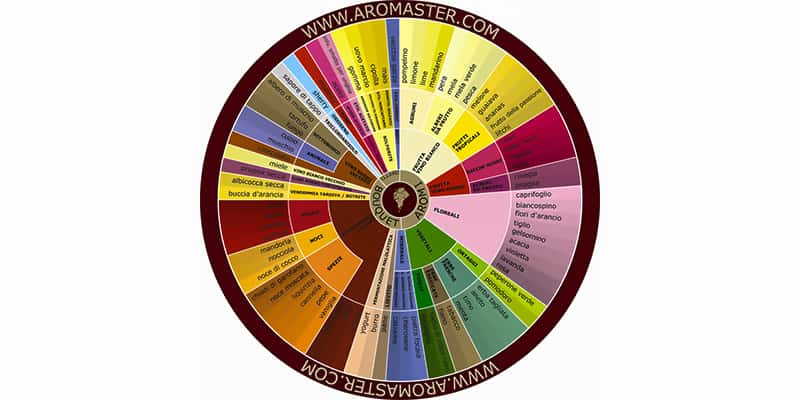
Here aromas are first described according to their family and, little by little as it progresses outward, one then finds more specific descriptions of the scents.
There aren’t very many aroma wheels on the market and all of them more or less resemble one another. I recommend this one by Aroma Master.
2) Smell spices and fruit to become familiar with their scents!
As Mr. Miyagi taught Daniel, it is from the most mundane gestures that we can learn the best lessons, to be pulled out in our moment of need as though possessed by a little karateka who lives within us.
So, my dear students, what I am suggesting might seem a bit bizarre, but trust me because the results are guaranteed.
Open the kitchen cabinets where you keep the spices, go to a florist, buy out the green grocer, and start sniffing everything within arm’s reach like bloodhounds, looking for scents!
Repeatedly smell individual spices and try to memorize them. Do the same with other smells, perhaps allowing yourself to be inspired by the scents on the aroma wheel.
You’ll see that after a bit of training, aromas will pop into your mind like magic when you smell a wine.
This technique is the same used as part of the treatment protocol after losing one’s sense of smell due to Covid. If you’d like to learn more on the topic, here’s the link.
3) Purchase several kits in order to become familiar with more unusual aromas.
Starting to smell the spices, fruits, and flowers in and near our homes is a good initial step…but how do we become familiar with aromas and smells that are difficult, if not impossible, to find?
Like the smell of flint, or eucalyptus, or even horse sweat?
This last one isn’t a joke, I swear. This is a smell that can be found in spoiled wine that has been attacked by an undesired yeast, the nauseating Brettanomyces Cerevisiae, or Brett for short.
A solution – though not a cheap one – is to have access to an aroma kit with pure essences that help us to learn what oak smells like, or mouse pee[1] (for those wondering, another “gift” from our dear friend Brett, mentioned above).
I recommend two, one smaller, the other more complete, but if you do an online search you’ll definitely find other solutions that suit your needs.
4) Study the potential scents of a varietal
Perhaps studying isn’t your forte, but if you’ve gotten this far then that means you’re an intrepid explorer of human knowledge. Or that you’ve never been able to identify even one aroma in a glass of wine and you’re desperate.
Don’t worry: there’s a solution to everything, but it takes some practice!
Every varietal, meaning every kind of grape, has certain characteristic aromas.
For example, Syrah has a strong and pungent scent of black pepper and Cabernet Franc is known for its green pepper aroma.
Unfortunately not all varietals have such specific distinguishing features, only those considered aromatic and semi-aromatic. The other grapes, the neutral ones (which account for most varietals) are more difficult to recognize because in these cases climate and region play a very important role as well.
It’s not necessary to memorize every varietal of course, but I do suggest that you learn the most famous or at least your favorites.
The steps, therefore, are:
– learn which are the main Italian varietals;
– learn which are the main scents used to describe them;
– taste the “single-varietal” wines, or those produced with a single kind of grape, in order to better distinguish their aromas.
I recommend starting with aromatic and semi-aromatic wines, or rather those produced with particularly fragrant grapes, because these possess a very high concentration of fragrant molecules and are rich in varietal aromas which make them recognizable.
Which are they? There aren’t very many in Italy or the world and must, unfortunately, be memorized, a bit like phrasal verbs in English.
AROMATIC
– Gewurztraminer: litchi, rose
– Brachetto: strawberry and orange zest
– Moscato: orange blossoms and citrus
– Malvasia: apricot, honey
SEMI-AROMATIC
– Sauvignon Blanc: grapefruit, tomato leaves, asparagus, cat pee
– Riesling: citrus and kerosene
– Glera (prosecco): green apple
– Chardonnay: Williams pear and dried fruit
– Syrah: black pepper
– Cabernet Franc: green pepper
5) Really smell a wine and take clues from its label
Now that we have several concepts under our belt, the time has come to put them into practice and move on to tasting.
To really smell a wine it’s important to:
– swirl the wine around in the glass (if it’s sparkling wine then skip this step)
– wait for the wine to settle in the glass and only then bring it to you nose (without disturbing it)
– now put your nose in the glass, without drowning in it, and inhale deeply.
Your nose reaches a point of saturation, so inhale several times but then remove the glass so that you’ll still be able to perceive the aromas.
A very useful “trick” when practicing at home is to read the back of the label, where the wine’s aromas are often specified.
While it’s clear that every mother loves her child, and that producers therefore exaggerate a bit in the description of their wine’s fragrances, it’s also true that having some scents for reference can help to better distinguish the aromas in the glass.
At this point try to identify the fragrances. Start with the families and then move on to more specific scents, trying to identify the aromas that you read on the label.
6) Choose the right glass!
There’s no sense in trying to smell the aromas of a wine if you’re practicing with a plastic cup.
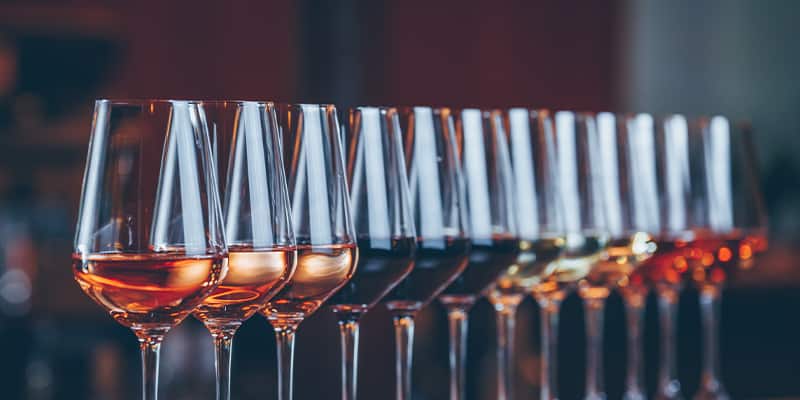
If you aren’t particularly well equipped and don’t happen to have a set of glasses for every type of wine, at least purchase a tulip-shaped tasting glass, like this one.
7) Do a tasting with someone who’s more of an expert than yourself
To improve your olfactory capacity, it’s a good idea to do some tastings with someone who is more of an expert than yourself.
Not only will they be able to suggest “instructional” bottles, but hopefully good ones as well!
8) Write down the aromas that you smell
When you do a tasting, I recommend keeping a book with you in which to take notes on the wine (name, winery, year) and on the aromas which stood out the most for you.
Writing them down will help you to memorize them better!
9) Do comparative tastings
Despite your training sessions, do wines continue to seem very similar to one another?
Then try comparing them in order to better notice their differences.
Pour two different wines at the same time and smell them, one at a time – making sure to pause between one “sniff” and the other. Try to evaluate the differences and take note of them.
You can try comparing wines made from the same grape or from different years. By doing this you’ll begin to appreciate how terrain and climate influence a wine’s flavor and fragrance.
10) Do you want to earn your black belt? Practice “blind” wine tastings
Blind wine tasting is an extreme sport for anyone who considers him/herself a wine connoisseur.
That thrill that travels down your spine as you courageously venture out among both familiar and entirely made up scents, afraid of being discovered.
Those who are truly fearless challenge fate by going so far as to try to guess the varietal and year of production.
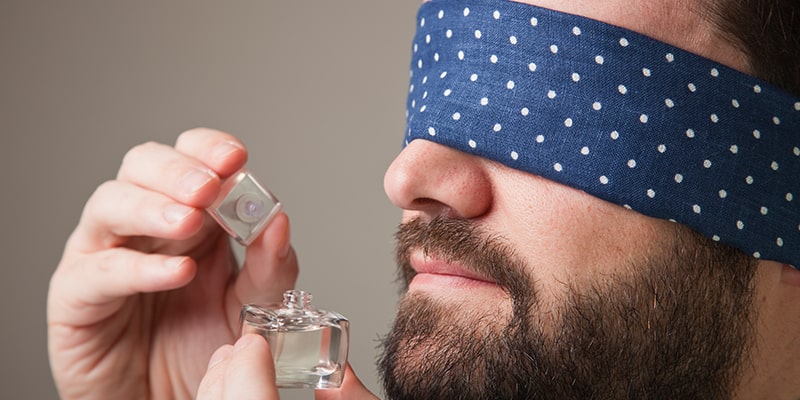
Don’t worry, I’m not suggesting that you do anything of the sort.
Rather, I recommend that you train your nose by blind-smelling fragrances and pure essences and then checking to see if you were right.
This will help you to train your sense of smell and give you an edge during those feared blind tastings, when you will have become a true champion.
Expect to smell those same aromas in wine, but a lot milder.
In addition to all of these suggestions, I’d like to add that of maintaining your curiosity and always opening as many bottles as possible, blindfolded or not. It’s best, however, to start with those that you like best.
Speaking of which, have you already taken our “taste test” to find out what your perfect wine is?
Ready to join the Vinhood family?

Vinhood is the First Italian Taste Agency. We explore the world of taste to guide people about how to choose and consume products and supporting companies in nurturing personalized relationships with their customers.
Read more
- Vinhood Academy second edition: being a Vinhood ambassador
 A Vinhood Ambassador recounts the experience after having taken part in the second Edition of the Vinhood Academy.
 - The wineries to visit while on vacation
 August is here, but events at wineries are still in full swing!
 - Eating and drinking at the time of Covid-19: what are the risks?
 What rules should we be following to avoid contagion by the Coronavirus via food? Is it dangerous to buy wine online? Elisabetta Aprili, Quality Inspector and Agrofood Consultant, helps us out by answering this and other questions.