La Pampa, exterior day, summer.
A patron in a bar sits down at a table and orders a “Fernandito”.
A waiter brings him Fernet, cola, and ice.
This scene repeats itself continuously, thousands of times a day.
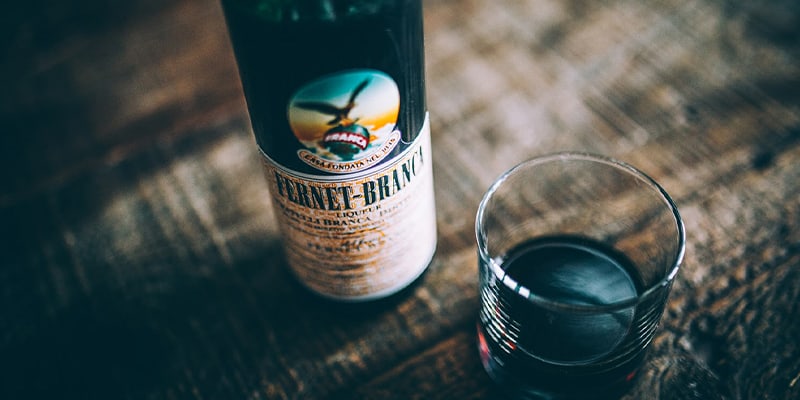
That’s because this historic Italian digestif is the most frequently drunk liqueur in Argentina, and, after wine and beer, is the most consumed alcoholic beverage in the country, so much so that it’s considered a national beverage.
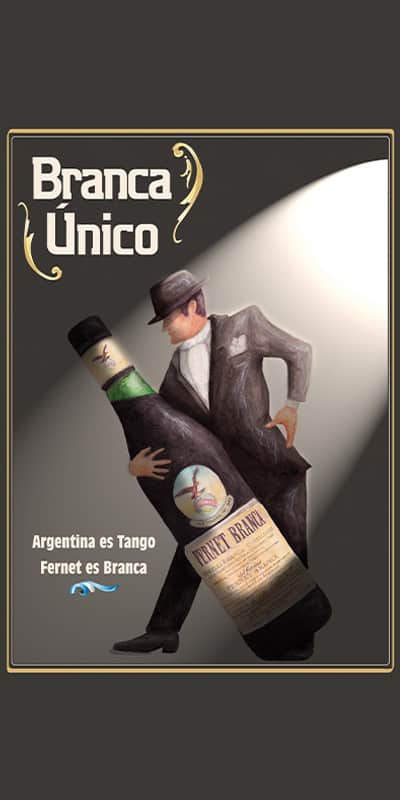
No, I’m not talking about fatuous or fleeting trends. Since the end of the 19th century, Fernet has become so deeply ingrained in Argentina’s culture that the Albicelestes think of it as Argentinian, even a symbol of the country!
DOCTOR VERNET’S ELIXIR OF LONG LIFE
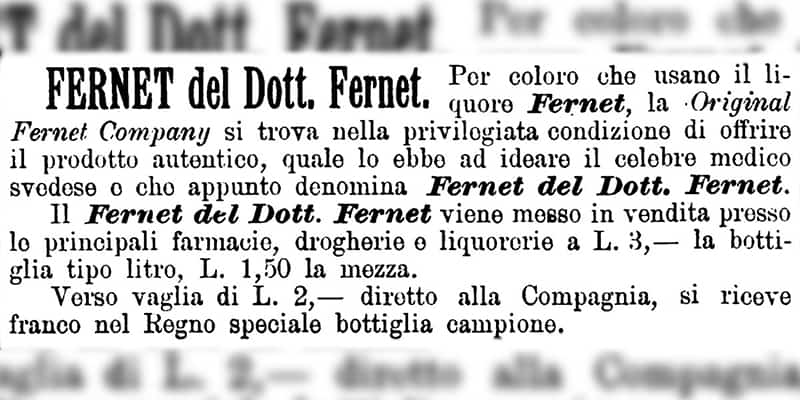
Fernet was first created in Italy, at the end of the 18th century, as an elixir of long life.
It was invented by a so-called (and nonexistent) Swedish doctor, Dr. Vernet, who passed away at the venerable age of 104 when he purportedly fell off of a horse!
Oh, the prodigious miracles of long ago inventions!
And it is thanks to this medicinal liqueur which he lavished upon his family daily, that his grandfather supposedly died at 130 years old, his father at 110, and his mother at “only” 107.
During the 19th century Fernet became the primary Italian remedy for sterilizing water, a disinfectant that was ahead of its time, in a country that was severely afflicted by cholera.

FROM MEDICINAL LIQUEUR TO DIGESTIF
Two main companies compete for the benchmark, both based in Milan: Fratelli Branca, in Porta Nuova, and Gaspare Campari, in Galleria Vittorio Veneto.
The former is the winner, having rediscovered the eternal Vernet, this time with an honorary degree in chemistry.
An elusive Scandinavian volunteer, who came down to Italy to fight in the Five Days of Milan (really?!), gave the recipe for the liqueur which he had invented as payment for the hospitality that he received in the Branca home.
In 1893 the University of Pavia declared Fernet to be medicinally ineffective.
However by then the die had been cast, and this Ambrosian liqueur remained a solid fixture of our customs and consumption, simply repositioning itself as a digestif, without major uproar.
THE DIGESTIF OF MIGRANTS
Argentina has approximately 45 million inhabitants, of which at least 25 million are of Italian descent.
An astonishing number that approaches 56% of the population, making it the largest ethnic group in the country.
The huge migratory influx that straddled the past two centuries led almost three million Italians to set sail for Puerto Madero, Buenos Aires, armed with cardboard suitcases full of hopes, dreams, and the essential (for the times) Fernet Branca.
All the more essential considering the social and cultural background of our Tanos (from Napolitanos), as our fellow countrymen were then called, who believed more firmly in their grandmothers’ remedies and in superstition, than in actual scientific truth.
Fratelli Branca International, an incredibly global company for the times, with production facilities in France, Switzerland, and the United States, sensed an excellent business opportunity and, in 1926 opened a branch in Argentina, in Tortuguitas. Today this location represents the group’s largest production hub and pulls in more than 40% of the brand’s total revenue.
No man is a prophet in his own land: the consumption of Fernet in Argentina is the highest in the world with 25 million liters per year, three times more than in Italy itself.

FERNANDITO, THE COCKTAIL OF ARGENTINA
In the 1970s, long before bitters were introduced to mixology in Italy, Oscar “El Negro” Becerra, bartender and owner of Premier a Ciudad de Cruz del Eje, simply combined cola, ice cubes and Fernet to create a drink that was considered the Cuba libre of Argentina: the Fernandito.
It was an overwhelming success, spreading from the Córdoba province, through the capital, and ultimately inundating the entire country.
Also amicably known as Fermao or Fefè, it’s the most popular and most frequently consumed cocktail in Argentina, so much so that the I.B.A. (the International Bartenders Association) added it to its list of official cocktails.
While today Fernet is, unfortunately, seen as dated in Italy, positioned like an industrial product on the shelves of large scale distribution outlets and severely lacking in hype, in the Tierra del Fuego it is unaffected by social class, trends, or status.
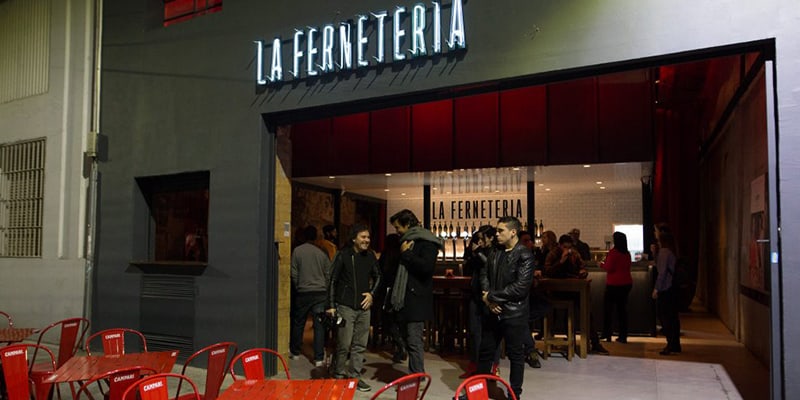
Fernet and Fernandito cut through all of that and are found, without distinction, from the most elegant Michelin-starred restaurant all the way to the smallest chiringuito in working-class neighborhoods (one particular spot stands out: La Ferneteria, in the Palermo neighborhood of Buenos Aires, where this Milanese digestif is added to even the most modern cocktails invented here).
In Argentina time seems to have stood still for Fernet Branca, similar to those Italian immigrants who eternally listen to Toto Cutugno’s “L’Italiano”.
And it’s in excellent company, alongside Cynar, Cinzano, and Vermouth (in addition to local imitations like Fernet Beney), here ever present, which have transformed from elixirs of long life to elixirs of eternal youth… at least for them.
Paraphrasing the words of Mexican author Octavio Irineo Paz Lozano, considered equal to Pablo Neruda and Jorge Louis Borges, the father of 20th century Hispanic literature: “The Argentinians are Italians that speak Spanish (and, I might add, drink Fernet) and believe themselves to be English.”





 The typical Italian is considered to be a curious drinker and when sitting at the table, wine is not the only companion. At the end of each meal, Italians know that they can always rely on a digestive aid. Born from centuries of research by pharmacists, monks, and even alchemists, this exquisite mixture of medicinal herbs infused in ethyl alcohol, has become over time an important and necessary tradition at the ending of every banquet.
 The lives of royals, explorers, and poets intertwine with one another in the incredible story of this liqueur.
 For years, bitters were underestimated and seen as a mere “ammazzacaffè” or “digestif”. Now thanks to cocktails and the art of mixology, they have become a trendy drink. We have highlighted 4 cocktails made from bitters that you can make at home or sip in a bar.