Homemade bread is one of the simplest and most satisfying things that you can make in the kitchen, even if you’re a novice.
Just a few ingredients, simple instructions, and a guaranteed result.
But if it’s true that there are many different kinds of bread, then it’s also true that there is only one basic recipe. The basic recipe for bread is always the same, with the same ingredients and the same proportions.
So what is it that makes the difference?
The kneading and proofing phases are certainly key elements for a successful bread.
For example, a recipe from a German bakery might require some modification if used on a muggy summer day in Apulia. In fact, climate and external conditions play a fundamental role in the preparation, especially during the proofing phase.

THE BASIC RECIPE
The basic recipe for a 1 kg loaf is:
-white flour: 580 gr
-water: 406 ml
-instant yeast 4 gr (or fresh yeast 12 gr)
-salt: 12 gr
Good flour must have an elevated capacity to absorb water and an adequate protein content. It’s quality is measured with the Windex present on the package or, as an alternative, on the producer’s website.
The protein content of the various kinds of flours is the following:
-pastry flour 9%;
-all-purpose flour 10.5%;
-bread flour 12.5%;
-high gluten flour 14%.
That which initiates fermentation and makes the dough rise. Let’s look at the different kinds:
-fresh brewer’s yeast: it’s a “live” yeast, made up of single-celled microorganisms, that must be stored in the refrigerator for about one month. A standard piece weighs 25 g and has a soft consistency and a light grey/beige color. Before using it, it must be crumbled and dissolved in warm water. The proofing that it generates lasts several hours, until the dough has doubled or tripled its volume;
-dry active brewer’s yeast: it comes in partially dehydrated granules. It must be rehydrated in water with a pinch of sugar, at a temperature of approximately 35°-38°C;
-instant yeast:it reacts more quickly and can be mixed directly into the flour, skipping the activation and rehydration phase. Specific strains of selected yeast, which are very resistant to the drying process, are used for its production.
We’re aware of the fact that there’s a sort of legend behind fresh yeast, which many consider the best solution for any recipe. But that’s not always the case! The only option is to try the best alternative for each recipe!
As simple as it is important.
Bottled water or tap water? Even in this case, we can’t give you a single answer to take as “absolute truth”. The important thing is to not use water with a very low fixed residue because the presence of minerals is fundamental to the proofing and crumb grain of our loaf.
Soft water, on the other hand, due to a lack of mineral salts, doesn’t help to strengthen the gluten and produces soft and sticky doughs. Alkaline water, or that with a pH > 7, can also negatively affect the dough, tending to neutralize the development of the proper acidity necessary for adequate proofing. The benefit of using bottled water is that one can establish these properties with precision, thanks to the “hardness” and “fixed residue” specifications on the label.
There’s not much to tell you about this last ingredient. Normal kitchen salt is perfectly fine for your recipe. Nevertheless, if you happen to have sea salt in your pantry, then we recommend opting for this second choice!
METHODS
During our exploration of basic bread preparation, we’ve seen that the ingredients to be used are always the same. Now we get to the more interesting part: the methods with which we can combine these ingredients. These methods vary and allow us to obtain breads with distinct characteristics.
But what are these methods?
- direct method: all of the ingredients are combined in a single phase and added respecting a precise order. Subsequently, the dough is left to rest for an amount of time that varies depending on the type of flour used and the type of recipe;
- semi-direct method: here too the ingredients are combined in a single phase, but with the use of carry-over dough, or rather, a piece of dough left over from the previous preparation and already mature;
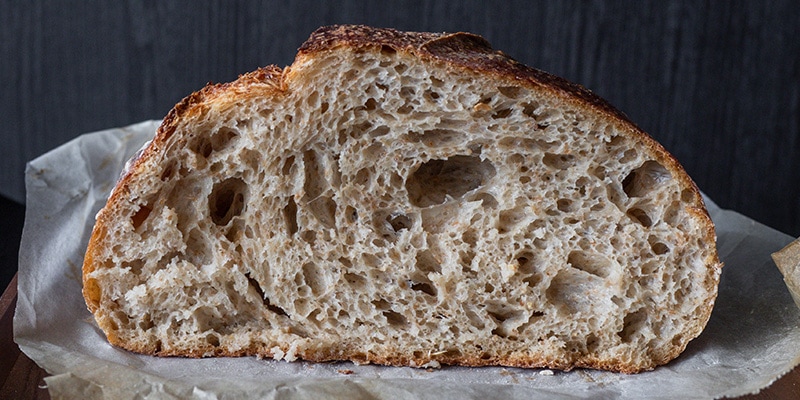
- indirect method: in this case there are two distinct phases. In the first phase, the pre-leavened dough (biga or poolish) is prepared and allowed to ferment, and only subsequently are all of the other ingredients added. The bread obtained with this method is more fragrant and has a more intense flavor, in addition to being more easy to digest thanks to the larger crumb grain.
PRE-LEAVENED DOUGHS
Biga is a dry and “shredded” dough. This kind of dough has a fermentation time that varies from 16 to 48 hours depending on the amount of yeast used and the temperature of the environment. The bread that’s obtained has a very soft crumb, characterized by a big and irregular crumb grain and excellent for soft focaccia and large leavened products.
Poolish is a rather liquidy dough made with the same amount of water and flour. The greater moisture content reduces maturation times. The bread that’s obtained using this pre-leavened dough is characterized by a small crumb grain and a crunchy surface, like ciabatta bread or baguettes.
All that’s left for you is to roll up your sleeves and start kneading.
Now you have a valid reason to empty the supermarket aisles of their yeast!




 The baguette: so important that it’s a candidate for UNESCO, so popular that it’s protected by a specific law.
 In Genoa people even eat it with their cappuccino. How, Where, and Why: Our Mini Guide to One of Italy’s Most Beloved Products.