The Nebiolos, like many emigrants from Piedmont at the start of the 20th century, did not remain in the United States but decided, after a few years overseas, to return home.
With the small nest egg that they had put aside during their time abroad, the couple decided to purchase a cafe in Turin, their native city.
They chose a very central location, the Caffé Mulassano, in which they invested 300,000 lire and all their creativity.
These were the years in which the city of Turin was in full cultural and financial swing.
Piazza Castello, where the cafe, with its beautiful wainscoting, was located, was a crossroads of intellectuals and entrepreneurs. Especially because this particular cafe served something that others in the city didn’t: the tramezzino sandwich.
FROM TOAST TO TRAMEZZINO
While doubt remains regarding the origins or many culinary products, when it comes to the tramezzino sandwich not only do we know for certain who created it, but we even know exactly when.
It was 1926 when Mrs. Angela Nebiolo, bringing together her American experience and her Turinese ingenuity, began serving sandwiches using “pancarrè”,
or sliced bread, with the crust removed.
In the United States the Nebiolos had purchased the prototype of a toaster and were among the first in Europe to serve toast, an important item on the cafe’s menu.
But, as the Italian film “Amici Miei” teaches us: “Genius is imagination, intuition, decision, and speed of execution.” The tramezzino brings all of these elements together: served cold and without the crust, filled with whatever you’d like, in the size that you prefer.
Angela realized the potential of this new version of toast and filled the cafe’s display with it.
What was in the first tramezzini? Definitely not ham and cheese, let alone capricciosa.
This was Piedmont, and the ingredients in the first tramezzino in history were simply butter and anchovies, with the addition – several years later – of peppers. This compelling story, however, wouldn’t be complete without a suitable name: tramezzino.
This is where the poet Gabriele D’Annunzio comes into the story, happening to be in Turin in that fateful year of 1926, where he decided to try the specialty that everyone in the city was talking about. The poet, seated at one of the tables in the cafe, after a first round of those little sandwiches served with vermouth, placed a second order, calling them “tramezzini”.
From picnics to breakfast, the world of outings away from home would never be the same.

SLICED BREAD, A JOKE ON THE EXECUTIONER
And the executioner? Right, because this story wouldn’t be complete without taking a further step backward, to that loaf of bread from which Angela Nebiolo removed the crust. Though it was already a well-known and popular product, at the time it was still rather new and, also in this case, from Turin.
Despite the lack of any clear records, a legend places its creation in Turin itself, but in the first half of the 19th century.
It was here, in a home on Via Franco Bonelli, that the last executioner, Piero Pantoni lived. He, like all of his predecessors, was not well-liked by his neighbors.
As a sign of their disdain, the bakers would give him his bread upside down, a custom that didn’t sit well with the executioner who eventually complained to the local authorities. Their solution was to expressly prohibit discriminatory acts, but the bakers – who were crafty – invented a type of bread shaped like a brick that could be served upside down with no one realizing it.
WHY IS IT CALLED PANCARRÉ?
This story is most likely made up, however it shines the light on a product known by a French name, pancarré, but which (at least during the same time period) was unknown beyond the Alps.
This isn’t surprising, however, because at the start of the 19th century it was common to give French names to foods and products, given that all culinary vocabulary came from the language of Brillat-Savarin.
That’s not all. Piedmont had always had a very close relationship with France, so this legend is entirely plausible.
In addition to flour, yeast, and water, however, milk and other fats like oil and butter also appear among the ingredients, which conceptually place it exactly halfway between traditional bread and French-style brioche, a very common fusion in Piedmont’s culinary tradition.
Is this further proof of the Turinese origins of one of the most well-known bread products in the world? Perhaps.
However another, and completely opposing, theory places its origins in the United States at the start of the 20th century, coinciding with the production of the first toasters. A soft, parallelepiped-shaped bread would be required in order to optimize mass production; a practical solution, perfect for the industrialization that was underway.
A more probable explanation, but one which D’Annunzio (and we alongside him) would certainly have been less fond of.




 Homemade bread is one of the simplest and most satisfying things that you can make in the kitchen, even if you’re a novice. Just a few ingredients, simple instructions, and a guaranteed result. But if it’s true that there are many different kinds of bread, then it’s also true that there is only one basic recipe.
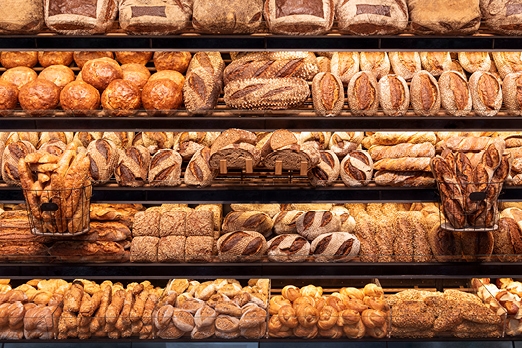 It’s our job to shed some light on baked bread, a universe characterized by countless names, picturesque crumbs, and crusts of various thicknesses and consistencies. It’s here that the #Characters rush to our aid.
 In Genoa people even eat it with their cappuccino. How, Where, and Why: Our Mini Guide to One of Italy’s Most Beloved Products.