
The art of tea preparation: rituals from around the world
Tea is one of the greatest contributions China has made to humanity. The history of this beverage which has won over all of civilization is complex and articulated. Here we’ll limit ourselves to a quick overview, exploring only the most important milestones of its spread and consumption.


From east to west, tea preparation spans the globe, bringing people together. In some contexts it can assume such an important social role that it’s elevated to the level of ceremony, in others it’s a sign of hospitality, a way of relaxing, or a rich nutrient.
Sipped alone or paired with sweet and salty foods, served hot or cold, sweetened or salted, flavored with spices or mint, with or without milk: there are infinite ways to enjoy tea. But before embarking on this exploration of rituals from around the world, it’s necessary to distinguish between two methods and two great traditions in the art of tea preparation: eastern and western.
The fundamental rules of these two schools of thought can be summarized as follows:
-the eastern, or Chinese, method:
- many tea leaves
- short steeping time
- multiple extractions
-the western, or Anglo-Saxon, method:
- few tea leaves
- long steeping time
- single extraction
There is no one preparation that’s superior to the others, but rather types of tea whose organoleptic characteristics are best expressed with a longer or shorter steeping time.
A BIT OF HISTORY
The history of tea dates back almost five thousand years!
The leaves of the plant, originally from the area between China, Laos, and Burma, were already being used as a bitter medicinal herb, blending and boiling them with spices and other curative remedies.
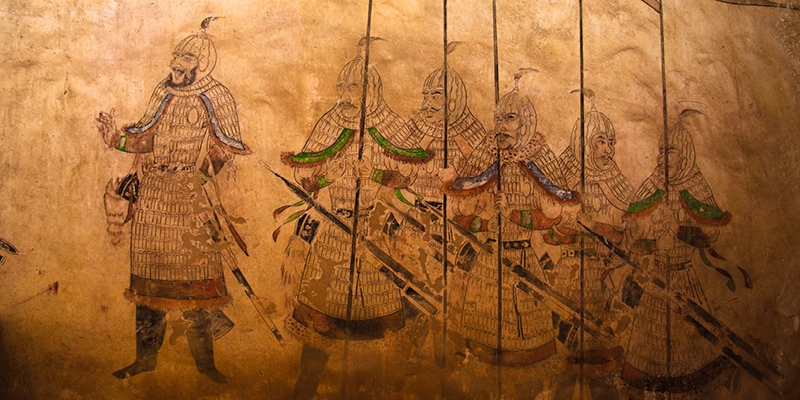
It wasn’t until the Tang dynasty (618-907), in China, that tea became a widely popular custom and source of artistic inspiration: painters, ceramic artists, and poets created a sophisticated universe that was permeated by symbolism around the tea ritual. Form this historic moment on, every subsequent dynasty has imposed its ways and, consequently, dictated new styles of preparation.
Tea is one of the greatest contributions China has made to humanity. The history of this beverage which has won over all of civilization is complex and articulated, and to thoroughly illustrate it would require a dissertation unto itself. Here we’ll limit ourselves to a quick overview, exploring only the most important milestones of its spread and consumption, starting with its birthplace, China.
THE GONG FU CHA PREPARATION STYLE
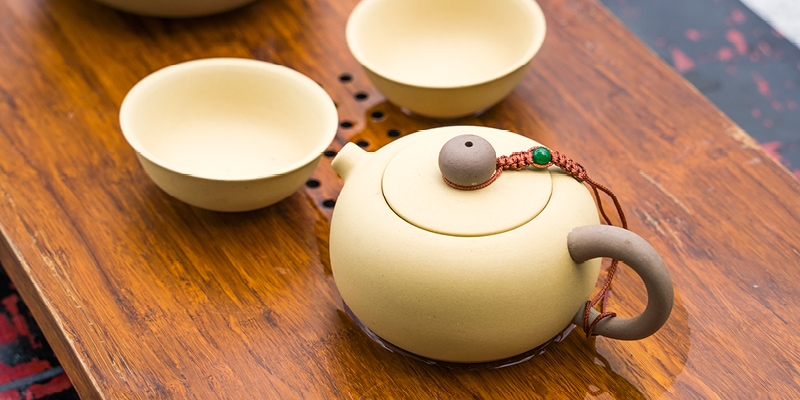
As previously mentioned, forget about large teapots and a single, long extraction: this is the land of multiple infusions, applying the modern rules of Gon Fu Cha preparation. Many call it a ceremony, but I prefer to call it an art: the art of “carefully and meticulously preparing” tea, without too many constraints. One can, in fact, steep the teas for more or less time, depending on one’s tastes, to obtain a more delicate or more intense extraction.
With its rule of “many tea leaves and an extraction of 10-60 seconds repeated 5-10 times”, this ritual allows the tea leaves to best release their aromas and express the full potential of each infusion.
The best accessories for this preparation are the gaiwan cup or the xi ying terracotta teapot.
Other equipment is also involved, like the ceremony table for the collection of liquids, on which the tools are arranged in an organized fashion: the terracotta teapot, or gaiwan, a small pitcher in which to pour the tea after each extraction, and the set of tasting cups (a tall one to appreciate the fragrances and a low one to exalt the flavors).
These objects must be rigorously heated with hot water before adding the tea leaves, and, once steeped, the teapot must be completely emptied so as to make it possible to steep the same leaves multiple times. Each step is different from those that came before it, ultimately resulting in a more delicate or more intense beverage. We suggest dedicating some time to this and experimenting, because the goal of Gong Fu Cha is to prepare tea in the best way possible.
CHA NO YU: THE ANCIENT ART OF JAPANESE TEA PREPARATION
The tea ritual in Japan is closely connected to the spread of Buddhism. In the 12th century, upon his return from a trip to China, a monk named Eisai brought with him the seeds of the tea plant and introduced the tea preparation method that was popular in China during the Song era: the leaves were pressed and then stone ground into a very fine powder. This beverage was, therefore, prepared by dissolution and not by infusion. This technique, now replaced in China by other styles imposed by subsequent dynasties over the centuries, is still very common in Japan.
Tea won over the imperial court and spread to the monasteries. In fact, thanks to this energizing beverage, the monks were able to remain awake during prayers and during long hours spent in meditation.
To this day, matcha (a very fine and intensely green powder) is used during the Cha No Yu tea ceremony.
Cha No Yu, literally “hot tea water”, is a ceremony in which harmony, respect, purity, and tranquility come together. The ceremony takes place in a tea room or “room of emptiness” which one enters after having walked through a long garden along a path paved with flat and irregular stones. Kneeling on the tatami mat just like the participants of the ceremony, the tea master or mistress dries the cup (chawan) with a silk cloth hanging from the belt of their kimono. With a bamboo whisk (chashaku), he or she pours a small amount of bright green matcha tea powder into a bowl. With a bamboo ladle (hishaku), he or she scoops some hot water from the cast iron kettle and pours it into the bowl over the tea. To obtain the “jade foam”, the two are mixed together vigorously with a special bamboo whisk (chasen).
The matcha is ready to be served to the first guest. The same ritual is repeated for each guest and each guest is served a small traditional sweet.
Remaining in the Land of the Rising Sun, leaf teas are also prepared with the same care. The distinguished Gyokuro and Sencha are steeped up to three or four times within the kyusu teapot, equipped with a lateral handle that makes it extremely practical and ergonomic. The first extraction lasts about one minute, while the second and third last just a few seconds. Meanwhile, for the fourth it’s necessary to lengthen the duration once again.
TEA IN INDIA: MASALA CHAI
An ancient Indian tradition used Masala, a blend of spices, as a medicinal remedy. When the English began to cultivate and produce tea in the Assam region, the addition of black tea to this mixture happened spontaneously, thus creating Masala Chai as we know it today: a very aromatic, strong, creamy, and satisfying beverage thanks to the addition of sugar and the boiling in water and milk.
There is no one recipe for Masala Chai. In fact, it’s said that every Indian family has its own! It’s prepared within small stalls and sold by Chai wallahs. It’s served hot, in clay cups called chullarhs, which are practically disposable: once the tea is finished, they’re thrown into the road and crushed, returning to the earth from which they came.
BUTTER TEA
Remaining on the slopes of the Himalayas, in Tibet, Nepal, and Bhutan people drink butter tea, also known as Po Cha. These mountain populations love to mix yak butter, salt, ginger, and boiling water with tea leaves. This truly unique and incredibly fortifying beverage is almost a necessity when it comes to enriching the diet of those who live at high altitudes and must brave the very harsh temperatures of the Himalayas.
THE ART OF TEA IN RUSSIA: THE SAMOVAR
The samovar and its use are traditional and essential expressions of Russian culture. Starting in the 19th century, the era in which tea spread throughout all of the Russian provinces, the samovar was considered the hearth of every home, a symbol of hospitality and welcome.
This object, with a unique aesthetic and function, is a sort of kettle that makes it possible to always keep water at the right temperature. At one time, the water was heated over a brazier. Now, however, samovars are electric and usually made from steel, even though they can also be found in more precious materials like silver, gold, and porcelain. At the top of the “chimney”, there’s a specific recess made to hold a teapot. To prepare tea in the Russian style a very concentrated, strong, and dark tea must be used, with the teapot full of approximately half water and half tea leaves. After having filtered the tea, the teapot is placed on the upper part of the samovar, where it stays hot thanks to the water vapor emanating from the chimney. Every time someone wants a cup of tea, 1-2 cm of concentrated tea (zavarka) are poured into a cup and diluted adding hot water that comes out of the samovar’s spigot. The tea is accompanied by blinis, milk, lemon peel, candied fruit, cloves, sugar cubes, and jam. A spoonful of this jam is placed on the palate, so that the tea is sweetened as one swallows it.
THE ART OF TEA IN MOROCCO: MINT TEA
Not just in Morocco, but in all of Northern Africa, offering and drinking mint tea has become a well-established daily custom, during commercial negotiations, to celebrate important family and life milestones, or simply to welcome a guest.
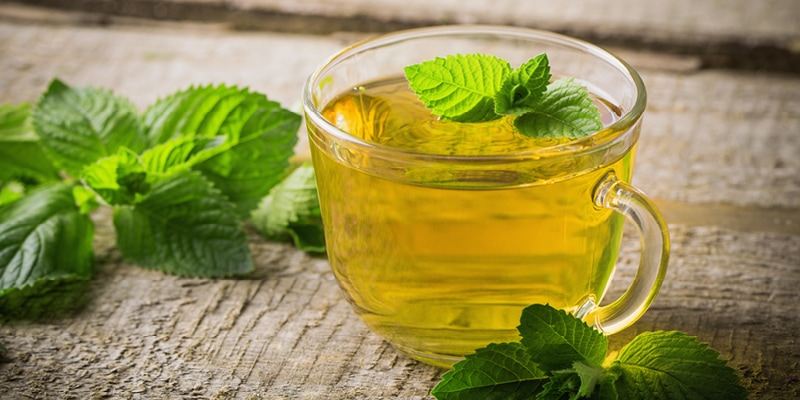
The Chinese green tea, Gunpowder, originally from Zhejiang, is the variety used in Morocco and in Arab countries in general. To prepare this mint tea, place approximately two spoonfuls of Gunpowder green tea in a silver or metal teapot, then pour a bit of boiling water onto the leaves, rinse quickly, and throw away the water. Add a handful of fresh Nana mint leaves and approximately 5-7 white sugar cubes. Pour fresh boiling water on the tea leaves and mint and allow to steep for approximately 4-5 minutes.
Put a spoonful of pine nuts into a colored cylindrical glass and then pour the tea into it, holding the teapot much higher than the glass in order to oxygenate the infusion.
The tea is served accompanied by pine nuts and traditional Arab sweets made with honey, coconut, walnuts, almonds, and sesame.
AFTERNOON TEA: THE “MADE IN ENGLAND” WAY
We end our journey in Europe…in London of course, where “afternoon tea” is a true institution! So much so that it has come to represent the definition of tea throughout the western world.
The rules for a perfect “made in England” cup of tea are:
-heat the teapot by pouring boiling water into it. Wait several moments, then throw it away;
-put a spoonful of tea leaves for each cup plus one for the teapot inside the teapot;
-pour water of the proper temperature into the teapot and wait approximately 3 minute for a single extraction before filtering it and serving it in porcelain cups.
The perfect “tea time” must be accompanied by scones, clotted cream, strawberry jam, small savory sandwiches, cakes, and pastries. The English adore their tea with milk and one or two sugar cubes. Tea is always prepared and served by the mistress of the house, who will fill her cup last, thus signaling that the others may feel free to begin drinking and digging into the calories!

Ready to join the Vinhood family?


Vinhood is the First Italian Taste Agency. We explore the world of taste to guide people about how to choose and consume products and supporting companies in nurturing personalized relationships with their customers.
Read more
- The accessories for preparing a good cup of tea
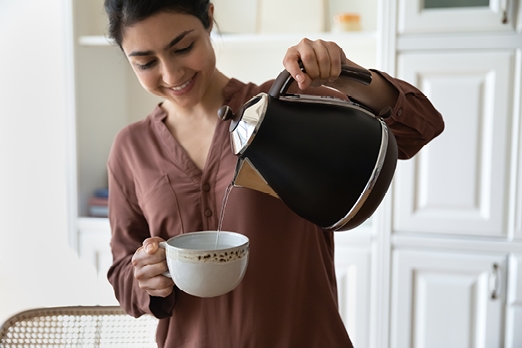 To prepare an exceptional cup of tea, we begin with the teapot. But the first and obvious question is: what kind is best?
 - Can you get good tea at a coffee bar?
 According to the ITC, approximately 100 million cups of tea are consumed in Great Britain each day, equal to almost 36 billion cups per year. But why is tea still struggling to catch on in Italy? Why is it so hard to find good tea at a coffee bar or hotel?
 - The colors of tea-part 2
 Terroir, cultivar, raccolti. E poi denominazioni geografiche, processi di produzione tramandati da generazioni. Vino? No, tè: un’unica pianta millenaria, quella della Camellia Sinensis, che genera una bevanda dai mille sapori e dai sei colori. Il tè viene, infatti, classificato in sei macro-categorie, paragonabili in Occidente alla distinzione tra vini rossi, bianchi e rosati.